

“The world is your oyster.”
That is probably something you were told at your secondary school graduation. Maybe by a principal, a teacher, or a well-meaning auntie.
You’re told that the world is open and full of promise; that anything is possible; that the horizon is wide, infinite, and yours for the taking.
But if you were born in Nigeria, you already know the odds are rarely in your favour. You know that while the world might be an oyster, you are starting the race 50 meters behind the block, often barefoot.
Being Nigerian is an exercise in obstacle management. You grow up with erratic electricity which limits how much you can create. You deal with unreliable systems and inflation that makes your money feel like it is evaporating in your hands. You are told to dream big, but the moment you open your laptop, NEPA takes the light.
And yet, despite all this, I maintain that it is possible to build for global relevance while living right here.
People have done it. Tunde Onakoya did it. Odunayo Eweniyi did it. Shola Akinlade and Ezra Olubi did it.
I’ve done it, too.
Now, you might be thinking, “Okay, but who are you, and what exactly gives you the right to speak on this topic?”
Fair question.
Without boring you with details, here are some highlights:
My name is Linda Ikechukwu. I currently work as a technical education lead at Smallstep Labs, a cybersecurity company based in the United States, where I somehow convinced them to pay me a high 6-figure USD salary. I am also an Executive MBA student at ESADE, a top-10 business school. I am a soon-to-be published international author with Apress, one of the most respected publishers in the technical world. You have probably read one of their titles without even knowing it. I am an international public speaker who has been invited to speak at conferences all around the world. I have now spoken at over 30 tech conferences across four continents, including Europe, North America, Asia, and Africa.
And I did all this without needing to leave Nigeria.
How, you ask?
When I examine the arc of my life, I see five recurring themes that I have always applied in different scenarios to bring me to where I currently am, without a single drop of privilege to lean on. These principles are career agnostic, so you can apply them no matter what you decide to do.
Let’s begin.
Volunteer to increase your surface area of luck
Access is power.

Environment matters a lot. There are places where opportunities circulate more freely than others, and you need to do everything you can to get in close proximity to such environments, even if it means volunteering.
As an undergraduate, when the university went on strike, a lot of students packed up and went home. I didn’t. I decided to stay back and volunteer at a learning centre that had just been set up through a collaboration between Huawei and my university’s computer science and engineering departments.
That decision turned out to be the beginning of everything.
While volunteering, I started learning about cloud computing and platform-as-a-service. These were terms that were completely new to me at the time, but I soaked them up.
More importantly, being in that space gave me access to information I wouldn’t have gotten anywhere else. It was there I first heard about Huawei’s internship pipeline. It was also through that center that I connected with my Head of Department, who later helped guide me through the application process.
Eventually, I got into the Huawei ICT competition. That opportunity put me directly in front of the Huawei internship selection team, and that is how I got my first job out of school in Lagos, a city where I didn’t know a single person.
Volunteering is one of the fastest ways to gain access to environments that you otherwise wouldn’t have access too. It’s also one of the fastest ways to seamlessly transition careers as I talked about in my “Ditch passion. Follow curiosity” essay.
Find or form a circle
If you want to go fast, go alone. If you want to go far, go together.

When I decided to pivot into software engineering, I knew it wasn’t something I could do in isolation. While I was still in school, I had already started teaching myself programming. I was learning HTML and CSS, building projects, and trying to understand how the internet worked.
When I moved to Lagos, I made it a point to find a community of people who were also learning and trying to grow. I didn’t know anyone in Lagos before I arrived, but I sought out those circles. I looked for people who were building in public and talking about what they were learning online. That community became the ecosystem that carried me into my first proper software engineering gig.
Later on, I noticed that there were some gaps between what I knew and what the market actually needed. So I went on Twitter and put out a message. I was looking for people who were serious about learning and willing to hold each other accountable. A few people responded, and together, we formed a study group.
We laid out a learning roadmap and stuck to it. We had weekly check-ins to go over what we had learned, and if anyone was stuck, someone else would jump in to explain.
By the end of that study period, everyone in that group had made progress. Some people were able to switch roles entirely while others passed technical interviews and landed higher-paying jobs. We didn’t need a fancy bootcamp or a structured online course. We just needed a shared goal, consistency, and each other.
If you are trying to grow, find a circle. And if you cannot find one, start one. You will be shocked how far a small, focused group can take you.
Pitch Yourself Relentlessly (It’s a Numbers Game)
You only need one yes. But sometimes, it takes ten no’s to find it. Rejection isn’t failure. It’s simply the price of entry.
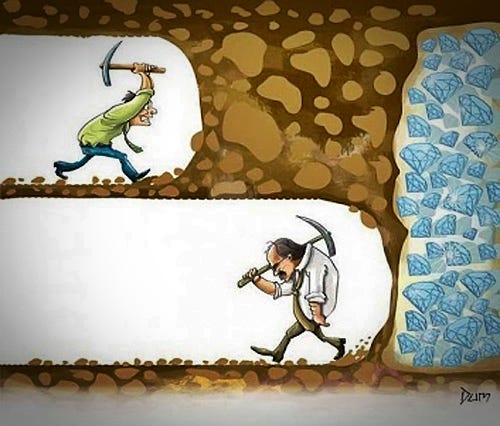
People often look at my book deal and assume it landed in my lap, but the truth is much less glamorous. When I decided I wanted to publish a book, I knew I wanted to do it with a renowned international publisher. I pitched to about five different publishing houses. Some ghosted me completely. Some responded and asked me to rework the entire idea, only to say no later. Some rejected me outright. Finally, Apress said yes. Now I am on my way to becoming an internationally published author, but it started with a series of asks.
I applied this same energy earlier this year when I decided to take my creator career a little more seriously. I have a travel page on Instagram, and I set a goal to make $1,000 in a month from brand promotions, even though I was a “newbie” creator. I didn’t wait to be discovered. I pitched to roughly ten brands. I ended up working with two, and that was enough to hit my $1,000 goal.
It is a numbers game. Even the giants we admire played this game. When the founders of Airbnb were starting out, they pitched to seven prominent investors. All seven rejected them. Some even walked out of the café. Today, Airbnb is a global giant. They didn’t win because their idea was perfect from day one; they won because they kept asking.
Pitching is simply a mechanism to increase your surface area of luck. You try, you fail, you adjust, and you try again. As the saying goes, closed mouths do not get fed.
Build a Public Library of Proof
No be by cho cho cho. Show workings.
Whenever I’m asked to give younger people the single most high-leverage piece of career advice I know, I always say: “Open a blog and start writing. Start writing about what you’re learning at work, your thought processes for executing projects, cheat codes you’ve discovered, and bespoke process adjustments you’ve made to what would be considered industry standards to optimise for faster outputs. Just write about what you do, how and why.”
I have always been a believer in having a medium to communicate proof of knowledge. For me, that medium has always been through writing.
I didn’t even realize the effects writing would have on my career. I mainly started writing because I discovered it is the most effective way for me to learn. Writing forces me to interact with the knowledge repeatedly. It compels me to articulate myself with such clarity that anyone who picks up my work can understand it. In that effort to teach others, I end up teaching myself because teaching is the fastest way to retain knowledge.
However, quite unplanned, putting my proof of knowledge in writing did more for my career than just helping me retain information. It unlocked opportunities I never could have imagined.
When I first started learning to code, I started off with a now-archived blog called CodeWithLinda.com. In one specific post, I explained the mechanics of cloud computing using an uber ride-booking analogy. That single piece of content went viral and opened doors I could not have forced open myself, eventually landing me a technical content consulting role with a global agency.
As I got more into technical writing, I launched EverythingTechnicalWriting.com. I used it to publish my specific philosophies on creating content for software engineers to drive product adoption and what I considered to be industry best practices. That site has done more for my career than any résumé ever could.
EverythingTechnicalWriting.com is read by people around the world. I have had strangers reach out from Poland, Mexico, and obscure corners of the globe to tell me that my writing helped them ace interviews or pivot their own careers. It was this visible evidence of my knowledge that led to an invitation to speak at Write the Docs, making me the first African to ever stand on that stage.
Evidence of my knowledge in writing also got me into B-Sides Poland, a high-level security conference where I was the only Black person and the only woman in the lineup. I did not network my way into that room. The evidence of my work got me there.
Even for my current role at Smallstep, the hiring manager told me during the interview that she had already seen my work in the wild and admired the quality and attention to detail I brought to the table. That was essentially where the interview ended, and how I got the job.
Your résumé is just a claim, but your public body of knowledge is living proof. Do not just work hard in private.
If the world cannot see it, the world cannot reward it.
So have a medium for letting the world know what you know.
Stay Curious, Even When It Makes No Sense Yet
Stupidity is usually just incuriosity.

They say curiosity kills the cat, but I say curiosity sets you free.
The people who win are rarely the ones who know it all. They are the ones who never stop learning and chasing their curiosities down a rabbit hole.
As an undergraduate, I looked forward to graduating because I used to think that once I left school, I wouldn’t be burdened with reading ever again. Some of you might be thinking so too. Boy, was I wrong. I have read more now than I ever did in Uni to get to where I am currently, and you will have to do the same.
Some of the biggest shifts in your life won’t start with a grand plan. They will start with a question. A moment of curiosity that won’t leave you alone. But curiosity is only useful enough to change your life when you move on it, even when it makes no sense at first.
Let me tell you how curiosity changed my life.
It started in university. I wasn’t studying computer science, and I didn’t know anyone working in tech. But during my second year, I stumbled on a random article that said people made money from blogging. So, naturally, I created a gossip blog using WordPress. I didn’t make any money, and I certainly didn’t go viral. But it made me ask: How is this thing even built? What’s under the hood of WordPress?
That tiny question pulled me into the world of web development. I Googled “how to build a blog from scratch,” taught myself HTML and CSS, and worked off a ₦60k second-hand laptop I bought with savings and a loan from my mum. I didn’t have a generator, so I coded during the rare hours we had electricity. I barely understood what I was doing for months. I’d open a JavaScript tutorial and feel like I was reading a different language. But I kept going. That curiosity eventually led to freelance gigs, then my first engineering job, and eventually to where I am now.
Years later, a similar thing happened. I got curious about technical writing. I didn’t know where it would lead; I just wanted to understand how to explain technical concepts better. So I started EverythingTechnicalWriting.com, a small blog where I wrote posts like “how to write great developer tutorials” or “how to explain passwordless authentication without sounding like a robot.” Again, no grand vision. Just one post at a time. As I have mentioned previously, that blog has opened up doors to opportunities for me in more ways than I can count.
For everything I have achieved, I can trace it all back to a moment of curiosity. A moment where I pondered, “How are people even doing this thing?” or “What would this look like?”
And that’s why I will encourage you to never stifle your curiosity and stay away from environments that try to do so.
Curiosity will save you.
The first two or three months might feel like confusion. You will feel lost. You will feel like you’re wasting time. But that confusion is the entry ticket. It’s the price you pay to get into a space you’ve never been in before.
In Conclusion, Excellence Has No Passport
I started this by telling you that the world is your oyster, but that for us born in Nigeria, the shell is much harder to crack. I stand by that. The reality of building a career from here is gritty. It is frustrating. It is unfair.
But here is the other truth I need you to leave with: Geography is no longer a prison.
The internet is the great equalizer. It does not care where you were born. It does not care about your surname. It does not care if NEPA took the light five minutes ago. It only cares about the quality of your output.
If you write code that solves a problem, that code works the same way in Lagos as it does in San Francisco. If you write an article that clarifies a complex topic, it is just as valuable to a reader in London as it is to a reader in Yaba.
Excellence has no passport.
You do not need a visa to have a global mind. You do not need to physically cross a border to have global relevance.
So, by all means, japa if that is your plan. Go where you feel you can thrive best. But do not make the mistake of thinking you must leave before you can become world-class. Do not pause your life waiting for a plane ticket.
Start now.
Volunteer to get in the room.
Find your circle to keep you moving.
Pitch yourself until you get a yes.
Build a library of proof so the world can see you.
Stay curious, even when you are confused.
The world is indeed your oyster, but it will not open itself. You have to pry it open with the quality of your work.
Go and build something global.
Thank you.
End Note:
Sometime in June of this year, members of the Google Developer Group (GDG) at Covenant University reached out to me. They asked me to deliver a keynote at their annual TechFest to inspire their students, particularly the graduating class.
The essay above is a condensed version of the speech I gave.
As an aside, I started 2025 wanting to do more speaking engagements in Nigeria. I realized that while I have done a lot of speaking outside the country, for some reason, I hadn’t had the privilege of doing much here at home.
I am really happy that I was able to change that this year. I delivered this keynote at Covenant University, another one at the Open Source Africa Festival (which I also published as an essay), and most recently, I was invited to be on a panel for the Jobberman Remote Work Fest.
This is my shameless way of plugging myself.
I want to do more speaking in Nigeria. So if any opportunities come up, plug me. I am available. I would like to do more keynotes, and yes, I charge a speaking fee :).
And that’s all I have for you today.
Love, from your favourite internet auntie.
Hope the December spirit has reached your side?
I'm so grateful for this post.
I'm just a medical student who doesn't really know much about writing and seeing something like this right now is so inspiring.
Waoo. I just found you.🥺❤️
Permit me to say, I’m stuck!